

Why are the plastic chairs in Vietnam so small?

When people arrive in Vietnam for the first time, one of the first questions they often ask is surprisingly simple.
“Why are the chairs so small?”
Not temples.
Not the traffic.
Not the food.
The stools.
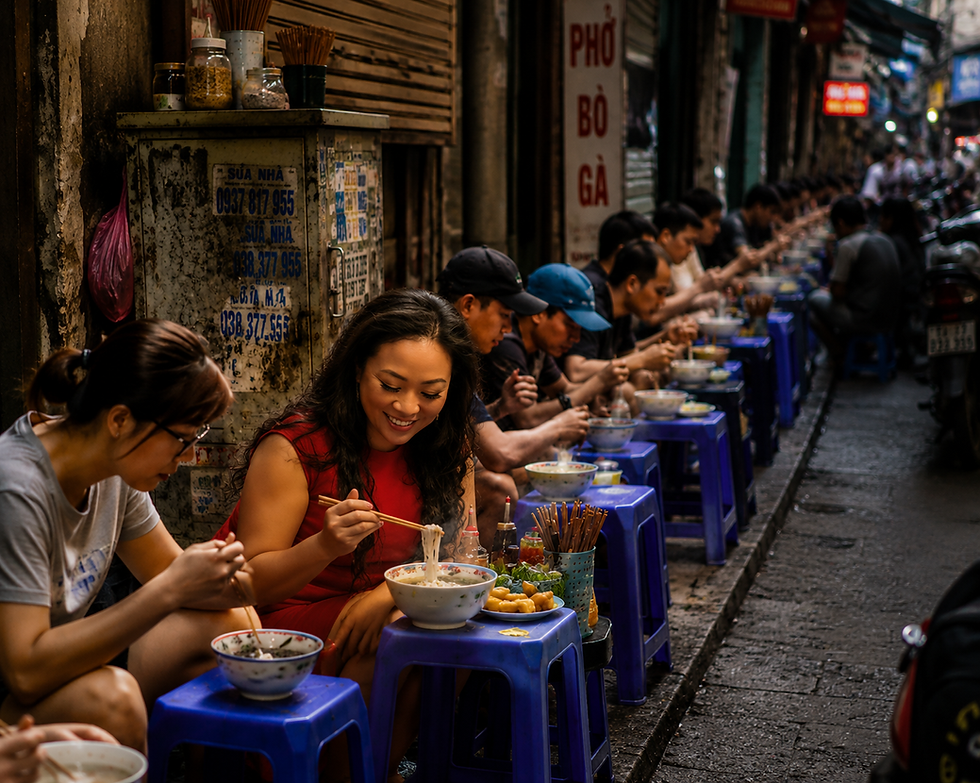
Tiny blue, red, or green plastic stools, barely 20 centimeters off the ground, scattered across sidewalks all over Hanoi and the rest of Vietnam. Foreign travelers stare at them with a mixture of amusement and concern, trying to imagine how an entire nation collectively decided that back support was optional.
I understand the reaction.

After living in Switzerland for 25 years before moving back to Vietnam, I saw them differently too when I returned. Or maybe more accurately — I suddenly saw them again.
Because once you’ve spent enough time in Europe, you become used to a very different relationship with space. Chairs are sturdy. Cafés are permanent. Public life is organized neatly into designated areas. You sit here. You walk there. The street belongs to movement, not lingering.
Vietnam feels almost opposite.
Here, life spills outward.
A living room becomes a sidewalk.
A sidewalk becomes a café.
A café becomes a noodle stall.
Five stools and a pot of broth become a business.
And then an hour later, it disappears again.
That’s what many travelers don’t realize at first: the plastic stools are not accidental. They are perfectly adapted to the rhythm of Vietnamese street life.
They are light enough to carry with one hand. Stackable in seconds. Cheap to replace. Flexible. Temporary. Mobile.
In a country where the street itself is constantly transforming, permanence is less important than adaptability.
Walk through Hanoi early in the morning and you’ll see it happen almost magically.
At 5:30 AM, an empty pavement.
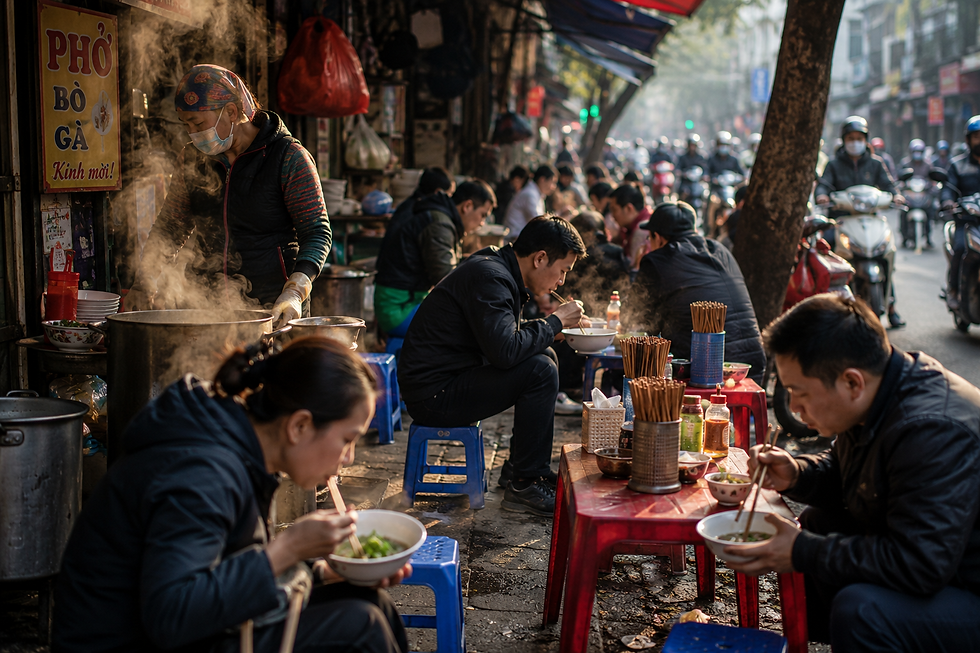
By 6:00 AM, a phở stall appears seemingly out of nowhere. Metal pots steaming. Fresh herbs piled high. Tiny stools arranged in uneven rows.
Office workers, motorbike taxi drivers, grandmothers, students — all sitting shoulder to shoulder, eating breakfast inches away from the flow of traffic.
Scooters rush past. Someone shouts an order. Coffee drips slowly through a metal filter into a glass of condensed milk. A woman cuts herbs with astonishing speed while balancing a phone between shoulder and ear.
Nothing matches. Everything works.
And somehow, nobody seems in a hurry to leave.
That part fascinated me most after moving back to Vietnam.
In Switzerland, public and private life are carefully separated. You meet people intentionally. Space is respected. Quietness itself is a kind of social contract.
Vietnamese street life is built on almost the opposite assumption: that human presence is normal.
Expected, even.
You are never very far from other people here.
Someone is always cooking. Talking. Watching. Fixing something. Sitting outside. Drinking tea. Folding laundry. Napping in a hammock. Negotiating loudly over fruit prices. Calling to a neighbor across the street.
Life happens visibly.
And the stools are part of that ecosystem.
Because they make gathering effortless.

You do not need reservations. You do not need interior design. You do not need “a concept.” You only need enough space for people to sit close together.
That closeness matters more than many visitors initially realize.
Western cultures — especially Northern European ones — often value personal space very highly. Physical distance equals politeness. Privacy equals respect.
Vietnamese culture is generally much more tolerant of physical proximity. Elbows touch. Motorbikes brush past each other by centimeters. Entire families ride on one scooter. Conversations happen loudly and collectively. Meals are shared from common dishes.
The stools reflect this too.
When you sit on them, you inevitably become part of the environment around you. You cannot fully isolate yourself. You are close to the street, close to the noise, close to the people beside you.
For many first-time visitors to Vietnam, this can initially feel chaotic.
Then something interesting happens.
Usually after a few days — maybe after one particularly good bowl of bún chả in Hanoi, or a late-night beer on a street corner while tiny plastic stools sink slightly into warm pavement — they begin to relax into it.

Their posture changes first.
At the beginning, foreigners often sit carefully, awkwardly, knees high, unsure how to position themselves. You can almost see their bodies resisting the experience.
But eventually they lean forward. One elbow on the table. Beer in hand. Laughing with strangers. Forgetting entirely about the chair beneath them.
And that’s usually the moment Vietnam starts making sense emotionally rather than intellectually.

Because Vietnam is not a country best experienced from behind glass.
Not from tour buses.
Not from rooftop lounges insulated from the street below.
Not from carefully curated distance.
Vietnam reveals itself at ground level.
And strangely enough, the tiny plastic stools symbolize that better than many grand monuments ever could.
Because they are not really about furniture at all.
They are about a culture that leaves room for spontaneity. A society where public life still belongs to ordinary people. A way of living where community happens naturally, without needing to be scheduled weeks in advance.
Maybe that is why so many travelers who initially laugh at the stools end up feeling oddly nostalgic about them after leaving Vietnam.
At some point, without realizing it, they stop seeing uncomfortable plastic chairs.
And start remembering conversations. Steam rising from soup. Morning coffee in Hanoi. The sound of spoons against bowls. The warmth of sitting close to other people while the city moves around them.
And perhaps that is the real answer to the question.
The chairs are small because, in Vietnam, life happens very close together.


Comments